Key Terms
Broadly, AI tools are any technologies, software, or platforms that utilize algorithms or artificial intelligence to analyze data, automate processes, or make predictions or recommendations. While there are many definitions of AI, AI is, in essence, software systems that take in data, learn from that data, and interpret it.
Machine Learning: As defined by the General Services Administration, the practice of using algorithms that are able to learn from large datasets by extracting patterns, enabling the algorithm to take an iterative and adaptive approach to problem-solving.
Generative AI: A type of AI that can produce new content in various formats — including text, imagery, audio, or data — based on user inputs and the datasets it has been trained on.
Natural Language Generation: As described by IBM, the process of converting structured data into human-like text.
Natural Language Processing: As described by IBM, the ability of a machine to interpret what humans are saying through text or voice formats.
Computer Vision: A type of AI that seeks to classify or identify objects, features, or people in images or videos.
AI Bias: A prejudiced determination made by an AI system, particularly when it is inequitable or oppressive or impacts socially marginalized groups.
AI Ethics: The multidisciplinary field that aims to employ standards of moral conduct to consider the societal and ethical implications of algorithmic development and use.
Categories of AI Tools for Newsrooms
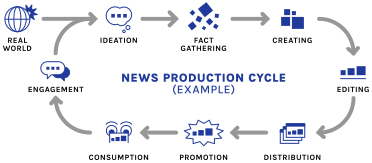
AI tools for newsrooms have various uses and can be used at different points in the news production process. To highlight this complexity, PAI analyzed more than 70 tools in our AI Tools for Local Newsrooms Database, providing plain-language descriptions of the AI tools and their uses and identifying five broad categories of AI tools relevant to journalists:
Lead Generation Tools provide advance notice of trends, developing stories, or witness leads on breaking news. These tools can help journalists identify trending topics and potential sources on the scene.
Content Creation Tools simplify and automate the news-writing and reporting process to help create content. Technologies like ChatGPT and other automated writing tools have made it increasingly easy to pull data and turn it into short articles about data-centric and factual content that requires editors’ review before publishing.
Audience Engagement Tools focus on collecting data and moderating audience interactions and comments. These can be used to provide data on user behaviors and interests or tailor content to audiences. Audience engagement tools also include recommender systems, which can personalize news recommendations based on user preferences.
Distribution Tools allow for a single piece of content to be shared in multiple languages or formats. Distribution tools can turn written content into audio, video, or images (and vice versa) or automate their distribution across many social media platforms.
Investigative and Data Analysis Tools support fact-finding and making sense of large datasets or a large number of documents. This makes it much easier to uncover patterns or hidden connections across documents, thereby reducing the amount of time and effort it takes to conduct investigative deep dives.
AI tools often have multiple features and can fall under multiple categories. For example, it is common for a tool to combine content creation and distribution functions. Step 3 of this guide addresses the unique risks associated with utilizing each of these categories of tools.
How AI Tools Differ From Other Newsroom Technologies
Several features differentiate AI tools from other software.
- Traditional software relies on a rules-based system where the outputs are the same every time. AI tools are iterative and often make decisions without explicit programming. Unlike with traditional software, we don’t always have insight into how AI systems arrive at their conclusions or the factors involved. AI tools therefore require an additional layer of oversight that might not have been previously necessary with traditional software that is “plug and play” and produces the same results using the same processes everytime.
- AI tools might not have the needed context to arrive at the correct conclusion (for example, when live-translating content) and thus need to be provided with that context through human oversight.
- AI tools may produce harmful outputs either unintentionally or through targeted attacks. While traditional software can suffer from similar vulnerabilities, the risk is amplified for AI tools. In turn, AI tools require that you continuously monitor how they operate, to ensure they continue to produce outputs that still align with their intended purposes.
These elements help justify the need for additional attention and governance when newsrooms adopt AI tools. This includes monitoring how data is being used to train models, the impact of those models, and determining thresholds for when tools are in need of retirement — all details described in more depth in the Guide.