How Bumble is preventing malicious AI-generated dating profiles


How can dating apps authenticate user profiles in the era of generative AI?

  • Bumble’s Photo Verification process requires users to provide unique photos to Bumble in order to validate the authenticity of their profiles. However, advances in generative AI technology have made using photos for validation increasingly challenging.
  • Bumble sought to balance two potentially conflicting goals: they sought to identify synthetic media when used to create fake or malicious profiles while simultaneously allowing individuals’ creative use of generative AI within their authentic profiles.
  • PAI’s Framework provided Bumble with a reference from which to identify the harm it sought to address, setting the stage for Bumble to roll out new policies on the use of synthetic media within the app.

This is Bumble’s case submission as a supporter of PAI’s Synthetic Media Framework. Explore the other case studies

Download this case study

How AI video startup Synthesia is scaling up content moderation at point of creation


Are content moderation and consent the best ways to combat misuse of AI technology?

  • In pursuit of both a sustainable and ethical business model, Synthesia sought consent from subjects whose likeness would be used to create synthetic videos as well as content moderation at the point of creation to help prevent its technology from being used to cause harm.
  • Synthesia’s goals were to build a trusted AI video platform while making AI video capabilities accessible, and contributing to a healthy synthetic content ecosystem. To do so, it had to implement content moderation at scale while navigating challenging gray-area cases.
  • The Framework provided Synthesia with a frame of reference for the implementation of its 3Cs principles: Consent, Control, and Collaboration.

This is Synthesia’s case submission as a supporter of PAI’s Synthetic Media Framework. Explore the other case studies

Download this case study

How the BBC used face swapping to anonymize interviewees


Is it possible to disclose AI use in a documentary without negatively affecting storytelling?

  • The BBC wanted to leverage AI tools to “face swap” interviewees in a documentary (instead of face blurring or pixelization) in order to more clearly tell a story.
  • The BBC knew it was necessary to be transparent about the use of AI and considered: how could they disclose to audiences that they were seeing synthetic faces?
  • By applying the Framework, the BBC was able to implement transparent direct disclosures that enabled documentary audiences to view the subjects without the bias that is typically inherent with traditional anonymization techniques.

This is the BBC’s case submission as a supporter of PAI’s Synthetic Media Framework. Explore the other case studies

Download this case study

AI Adoption for Newsrooms: A 10-Step Guide

A step by step guide to the responsible adoption of AI tools in newsrooms

AI is already changing the way news is being reported.

AI tools can alert journalists to breaking news, help them analyze and draw insights from large datasets, and even write and produce the news. At the same time, the risks associated with using AI tools are significant and varied. From potentially spreading misinformation to making biased statements, the cost — both literally and figuratively — of misusing AI in journalism can be high.

Partnership on AI (PAI), as part of the Knight Foundation’s AI and Local News Initiative, has been working with organizations and individuals from the technology and news industries, civil society, and academia to explore how journalists can ethically adopt AI. AI Adoption for Newsrooms: A 10-Step Guide is the latest addition to PAI’s AI and Local News Toolkit, a set of resources designed to help local news organizations responsibly harness AI’s potential.


Informed by 5 Key Principles for AI-Adopting Newsrooms, the Guide provides a step-by-step roadmap to support newsrooms navigating the difficult questions posed by AI tool identification, procurement, and use.

Beginning with Step 1, “Identifying the outcomes and objectives of adding an AI tool” and ending with Step 10, “When you should retire an AI tool,” AI Adoption for Newsrooms takes newsrooms through the entire AI adoption journey, illustrated with real-world examples of newsrooms that have incorporated AI tools.

Download the Guide

How This Guide Was Created

Over the past year, we worked with journalists and newsroom leaders to understand their most pressing questions related to responsibly procuring and using AI tools. We’ve also interviewed AI tool developers to understand why they’ve developed these tools and what risks they foresee with adoption. In January 2023, we launched the AI and Local News Steering Committee, a group of nine experts currently working in the AI and news sectors, including representatives of industry, newsrooms, civil society, and academia. The Steering Committee has focused primarily on providing input and direction on the content and development of this Guide.

Who This Guide Is For

While the Guide is primarily written for newsrooms looking to procure new AI tools, it is also applicable to newsrooms that have already procured AI tools or are considering building their own. In this guide, procurement is covered in the first 7 steps, while the remaining 3 steps cover the governance and use of AI tools within the newsroom. The steps are written to allow users to jump into the Guide at any step depending on where their newsroom is in the procurement and adoption process. Throughout the Guide, we seek to balance usability with sufficient nuance and depth.

The responsible use of AI tools is part of upholding long-standing journalistic values of integrity, transparency, and accountability. Journalists should strive to apply the same level of rigor and scrutiny to AI tools as to sources in news stories. This is how we can ensure that the AI tools that are adopted are serving the newsroom and audiences’ best interest and do not amplify bias, increase misinformation, or put the newsroom’s credibility at stake. To that end, we guide newsrooms through the questions they should be asking at every step of the way in their journey of procuring and using an AI tool, with insights derived from a multidisciplinary community — including other newsrooms — who have already used AI tools.

What Responsible AI Adoption Looks Like

Responsible procurement and use of AI tools requires understanding the ethical implications of such tools, including how to maximize their benefits while appropriately assessing their risks. This necessitates a broader newsroom effort — between journalists, editors, and organization leaders — to put governance in place that ensures appropriate use and monitoring throughout an AI tool’s lifecycle.

AI tools can be used for many different purposes and have various degrees of complexity. As a result, the responsible adoption of AI can look different depending on the newsroom and what tools they are incorporating. For that reason, this Guide poses many questions for journalists, editors, and management to help determine what responsible AI stewardship looks like for their newsroom, whether they are looking to procure an AI tool or create their own. This may seem like a lot of work upfront for what otherwise might be a simple process. Answering these questions at the outset, however, will save newsrooms a lot of time and energy compared to retroactively figuring out responsible use of a tool after purchasing it, training it, and using it.

Scope Limitations of This Guide

Introducing AI technology in journalism requires internal management and preparation in the newsroom — not only for technical skills, but also for the cultural change it requires, taking into account the emotional needs and morale of those in the newsroom. The Guide does not touch upon the organizational and cultural impact of AI adoption, but we would like to note that it is an important consideration that is required to ensure the success of AI adoption in a newsroom. Journalists and team members should feel comfortable using the tool as an aid, not as a replacement for their work. In addition, it is important that journalists can provide their input into decision-making processes and have a real say in the AI tools chosen to aid in their work. For more on this, we encourage you to utilize PAI’s Guidelines for AI & Shared Prosperity and refer to our report on AI and Job Quality.

Key Terms

Broadly, AI tools are any technologies, software, or platforms that utilize algorithms or artificial intelligence to analyze data, automate processes, or make predictions or recommendations. While there are many definitions of AI, AI is, in essence, software systems that take in data, learn from that data, and interpret it.

Machine Learning: As defined by the General Services Administration, the practice of using algorithms that are able to learn from large datasets by extracting patterns, enabling the algorithm to take an iterative and adaptive approach to problem-solving.

Generative AI: A type of AI that can produce new content in various formats — including text, imagery, audio, or data — based on user inputs and the datasets it has been trained on.

Natural Language Generation: As described by IBM, the process of converting structured data into human-like text.

Natural Language Processing: As described by IBM, the ability of a machine to interpret what humans are saying through text or voice formats.

Computer Vision: A type of AI that seeks to classify or identify objects, features, or people in images or videos.

AI Bias: A prejudiced determination made by an AI system, particularly when it is inequitable or oppressive or impacts socially marginalized groups.

AI Ethics: The multidisciplinary field that aims to employ standards of moral conduct to consider the societal and ethical implications of algorithmic development and use.

Categories of AI Tools for Newsrooms

AI tools for newsrooms have various uses and can be used at different points in the news production process. To highlight this complexity, PAI analyzed more than 70 tools in our AI Tools for Local Newsrooms Database, providing plain-language descriptions of the AI tools and their uses and identifying five broad categories of AI tools relevant to journalists:

Lead Generation Tools provide advance notice of trends, developing stories, or witness leads on breaking news. These tools can help journalists identify trending topics and potential sources on the scene.
Content Creation Tools simplify and automate the news-writing and reporting process to help create content. Technologies like ChatGPT and other automated writing tools have made it increasingly easy to pull data and turn it into short articles about data-centric and factual content that requires editors’ review before publishing.
Audience Engagement Tools focus on collecting data and moderating audience interactions and comments. These can be used to provide data on user behaviors and interests or tailor content to audiences. Audience engagement tools also include recommender systems, which can personalize news recommendations based on user preferences.
Distribution Tools allow for a single piece of content to be shared in multiple languages or formats. Distribution tools can turn written content into audio, video, or images (and vice versa) or automate their distribution across many social media platforms.
Investigative and Data Analysis Tools support fact-finding and making sense of large datasets or a large number of documents. This makes it much easier to uncover patterns or hidden connections across documents, thereby reducing the amount of time and effort it takes to conduct investigative deep dives.

AI tools often have multiple features and can fall under multiple categories. For example, it is common for a tool to combine content creation and distribution functions. Step 3 of this guide addresses the unique risks associated with utilizing each of these categories of tools.

How AI Tools Differ From Other Newsroom Technologies

Several features differentiate AI tools from other software.

  1. Traditional software relies on a rules-based system where the outputs are the same every time. AI tools are iterative and often make decisions without explicit programming. Unlike with traditional software, we don’t always have insight into how AI systems arrive at their conclusions or the factors involved. AI tools therefore require an additional layer of oversight that might not have been previously necessary with traditional software that is “plug and play” and produces the same results using the same processes everytime.
  2. AI tools might not have the needed context to arrive at the correct conclusion (for example, when live-translating content) and thus need to be provided with that context through human oversight.
  3. AI tools may produce harmful outputs either unintentionally or through targeted attacks. While traditional software can suffer from similar vulnerabilities, the risk is amplified for AI tools. In turn, AI tools require that you continuously monitor how they operate, to ensure they continue to produce outputs that still align with their intended purposes.

These elements help justify the need for additional attention and governance when newsrooms adopt AI tools. This includes monitoring how data is being used to train models, the impact of those models, and determining thresholds for when tools are in need of retirement — all details described in more depth in the Guide.


5 principles of AI adoption for newsrooms

The step-by-step Guide below is informed by a set of recommendations for the ethical adoption of AI by newsrooms previously published by PAI. These principles are:

  1. Newsrooms need clear goals for adopting AI tools
  2. Technology must embody the standards and values of the news operation
  3. Transparency, explainability, and accountability mechanisms must accompany the implementation of AI tools
  4. Newsroom staff need to actively supervise AI tools
  5. Distribution platforms must embed journalistic values into their AI systems

For a more in-depth understanding of these recommendations please read PAI’s blog post on the topic.


10 Steps for AI Adoption in Newsrooms

This Guide recommends newsrooms follow a 10-step process for adopting AI tools.

Working through the steps, if you discover by Step 2 that your newsroom’s needs won’t be addressed by an AI tool but are instead structural or organizational, consider addressing those first before proceeding. If by Steps 6 and 7, you find none of the AI tools meet your needs, hold off on adopting an AI tool. The sunk cost of time spent researching and testing out a tool is likely far smaller than implementing one that doesn’t meet your needs or doesn’t meet the standards for responsible AI that you’ve set.

Tap to expand:

1

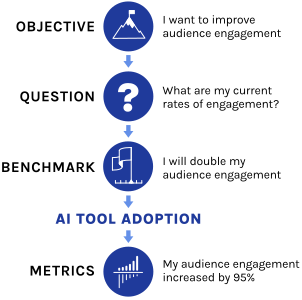
Identify the outcomes and objectives of adding an AI tool

2

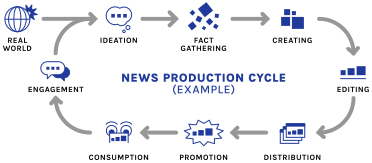
Map out your news production cycle and where an AI tool might fit into existing systems

3

Pinpoint the category of tools you’ll be considering and understand the associated risks

4

Establish performance benchmarks

5

Shortlist three to five potential AI tools and interview the tool developers

6

Select one or two tools that you would like to procure

7

Outline the potential benefits and drawbacks of implementing this tool

8

Set up your newsroom for success after procurement

9

Understand the lifecycle of an AI tool

10

Determine when you should retire an AI tool

Acknowledgements

AI Adoption for Newsrooms was iteratively developed by PAI’s AI and Media Integrity team under comprehensive guidance from the AI and Local News Steering Committee. We’d like to thank the Steering Committee members for their commitment to this programmatic work and for their generosity in time, expertise, and effort to advance this project. Their astute contributions and detailed comments on earlier drafts have strengthened this work immensely.

We would also like to thank the Partnership on AI staff who championed this work and provided thoughtful feedback and ideas throughout the research and writing process: Claire Leibowicz, Stephanie Bell, Hudson Hongo and Neil Uhl.

Finally, PAI is grateful to the Knight Foundation for their financial support and thought partnership of the AI and local news work — and personally grateful to Marc Lavalee, Director of Technology, for his wisdom and energy.

If you would like to add to this work or to the list of resources available, to utilize this guide as part of your newsroom’s journey, or just to be involved in our future work at the intersection of AI and news, please email Dalia Hashim.

Human-AI Collaboration Trust Literature Review: Key Insights and Bibliography

PAI Staff

Key Insights from a Multidisciplinary Review of Trust Literature

Key Insights from a Multidisciplinary Review of Trust Literature

Understanding trust between humans and AI systems is integral to promoting the development and deployment of socially beneficial and responsible AI. Successfully doing so warrants multidisciplinary collaboration.

In order to better understand trust between humans and artificially intelligent systems, the Partnership on AI (PAI), supported by members of its Collaborations Between People and AI Systems (CPAIS) Expert Group, conducted an initial survey and analysis of the multidisciplinary literature on AI, humans, and trust. This project includes a thematically-tagged Bibliography with 78 aggregated research articles, as well as an overview document presenting seven key insights.

These key insights, themes, and aggregated texts can serve as fruitful entry points for those investigating the nuances in the literature on humans, trust, and AI, and can help align understandings related to trust between people and AI systems. This work can also inform future research, which should investigate gaps in the research and our bibliography to improve our understanding of how human-AI trust facilitates, or sometimes hinders, the responsible implementation and application of AI technologies.

Key Insights

Several high-level insights emerged when reflecting on the bibliography of submitted articles:

  1. There is a presupposition that trust in AI is a good thing, with limited consideration of distrust’s value.
    The original project proposal emphasized a need to understand the literature on humans, AI, and trust in order to eventually determine appropriate levels of trust and distrust between AI and humans in different contexts. However, the articles included in the bibliography are largely framed with the need and motivation towards trust – not distrust – between AI systems and humans. While certain instances may warrant facilitated trust between humans and AI, others may actually enable more socially beneficial outcomes if they prompt distrust or caution. Future literature should explore distrust as related, but not necessarily directly opposite, to the concept of trust. For example, an AI system that helps doctors detect cancer cells is only useful if the human doctor and patient trust that information. In contrast, individuals should remain skeptical of AI systems designed to induce trust for malevolent purposes, such as AI-generated malware that may use data to more realistically mimic the conversational style of a target’s closest friends.
  2. Many of the articles were published before the Internet’s ubiquity/the social implications of AI became a central research focus.
    It is important to contextualize recent literature on intelligent systems and humans with literature focused on social and cognitive mechanisms undergirding human to human, or human to organizational, trust. Future work can put many of the foundational, conceptual articles that were written before the 21st century in conversation with those specifically focused on the context of AI systems, and their different use cases. It can also compare foundational, early articles’ exploration of trust with how trust is seen specifically in relation to humans interacting with AI.
  3. Trust between humans and AI is not monolithic: Context is vital.
    Trust is not all or nothing. There often exist varying degrees of trust, and the level of trust sufficient to deploy AI in different contexts is therefore an important question for future exploration. There might also be several layers of trust to secure before someone might trust and perhaps ultimately use an AI tool. For example, one might trust the data upon which an intelligent system was trained, but not the organization using that data, or one might trust a recommender system or algorithm’s ability to provide useful information, but not the specific platform upon which it is delivered. The implications of this multifaceted trust between human and AI systems, as well as its implications on adoption and use, should be explored in future research.
  4. Promoting trust is often presented simplistically in the literature.
    The majority of the literature appears to assert that not only are AI systems inherently deserving of trust, but also that people need guidance in order to trust the systems. The basic formula is that explanation will demonstrate trustworthiness, and once understood to be deserving of trust, people will use AI. Both of these conceptual leaps are contestable. While explaining the internal logic of AI systems does, in some instances, improve confidence for expert users, in general, providing simplified models of the internal workings of AI has not been shown to be helpful or to increase trust.
  5. Articles make different assumptions about why trust matters.
    Within our corpus, we found a range of implicit assumptions about why fostering and maintaining trust is important and valuable. The dominant stance is that trust is necessary to ensure that people will use AI. The link between trust and adoption is tenuous at best, as people often use technologies without trusting them. What is largely consistent across the corpus – with the exception of some papers concerned about the dangers of overtrust in AI – is the goal of fostering more trust in AI, or stated differently, that more trust is inherently better than less trust. This premise needs challenging. A more reasonable goal would be that people are able to make individual assessments about which AI they ought to trust and which they ought not trust, in the service of their goals for what specifically and in which circumstances. This connects to insight 1: There is a presupposition that trust in AI is a good thing. It is important to think about context, person-level motivations and preferences, as well as instances in which trust might not be a precondition for use or adoption.
  6. AI definitions differ between publications.
    The lack of consistent definitions for AI within our corpus makes it difficult to compare findings. Most articles do not present a formal definition of AI, as they are concerned with a particular intelligent system applied in a specific domain. The systems in question differ in significant ways, in terms of the types of users who may need to trust the system, the types of outputs that a person may need to trust, and the contexts in which the AI is operating (e.g., high- vs. low-stakes environments). It is likely that these entail different strategies as they relate to trust. There is a need to develop a framework for understanding how these different contributions relate to each other, potentially looking not at trust in AI, but at trust in different facets and applications of AI. For a more detailed analysis of what questions to ask to differentiate particular types of human-AI collaboration, see the PAI CPAI Human-AI Collaboration Framework.
  7. Institutional trust is underrepresented.
    Institutional trust might be especially relevant in the context of AI, where there is often a competence or knowledge gap between everyday users and those developing the AI technologies. Everyday users, lacking high levels of technical capital and knowledge, may find it difficult to make informed judgments of particular AI technologies; in the absence of this knowledge, they may rely on generalized feelings of institutional trust.

About the Bibliography

About the Bibliography

The CPAI Trust Literature Bibliography includes 78 thematically tagged research articles (with references and abstracts). The article selection process sourced content from a multidisciplinary community all aligned around an interest and expertise in human-AI collaboration. Submitted articles were evaluated for inclusion and analyzed by members of a smaller project group from within the PAI Partner community. An analysis of the almost 80 initial articles resulted in the development of four thematic tags, highlighting the ways the article abstracts approached the issue of trust. Specifically:

Understanding – lays out a conceptual framework for trust or is primarily a survey of trust-related issues.
Promoting – focuses on means for increasing trust
Receiving – focuses on the entity (e.g., a robot, a system, a website) that is trusted
Impacting – focuses on the nature of changes due to trust being present (e.g., the impact on a group or an organization when it experiences trust)
Two individuals from the smaller project group undertook a thematic tagging exercise to assess inter-rater reliability and the distribution of themes across articles. They tagged themes as primary and secondary (first and second order) for each article from the four thematic options above.

The CPAIS Trust Literature Bibliography identifies thematic tags for each article, at levels 1 and 2. The “themes” column lists the first order themes and the second order themes, where applicable. The total tags for each article (at both levels) are also provided. “Understanding trust” was the most frequent theme – used with 61 articles (78% of the total). 50 articles (64%) were tagged with “promoting trust,” and 29 articles (37%) were tagged with “receiving trust”. Finally, 13 articles (16%) were tagged with a focus on impacting trust.

This bibliography and thematic tags serve as fruitful entry points for those investigating the nuances in the literature on humans, trust, and AI, especially when contextualized with the insights drawn from the corpus presented above.

DOWNLOAD INSIGHTS            VIEW BIBLIOGRAPHY

Human-AI Collaboration Framework & Case Studies

PAI Staff

Overview

Overview

Best practices on collaborations between people and AI systems – including those for issues of transparency and trust, responsibility for specific decisions, and appropriate levels of autonomy – depend on a nuanced understanding of the nature of those collaborations.

With the support of the Collaborations Between People and AI Systems (CPAIS) Expert Group, PAI has developed a Human-AI Collaboration Framework, containing 36 questions that identify some characteristics that differentiate examples of human-AI collaborations. We have also prepared a collection of seven case studies that illustrate the Framework and its applications in the real world.

This project explores the relevant features one should consider when thinking about human-AI collaboration, and how these features present themselves in real-world examples. By drawing attention to the nuances – including the distinct implications and potential social impacts – of specific AI technologies, the Framework can serve as a helpful nudge toward responsible product/tool design, policy development, or even research processes on or around AI systems that interact with humans.

As a software engineer from a leading technology company suggested, this Framework would be useful to them because it would enable focused attention on the impact of their AI system design, beyond the typical parameters of how quickly it goes to market or how it performs technically.

“By thinking through this list, I will have a better sense of where I am responsible to make the tool more useful, safe, and beneficial for the people using it. The public can also be better assured that I took these parameters into consideration when working on the design of a system that they may trust and then embed in their everyday life.”

SOFTWARE ENGINEER, PAI RESEARCH PARTICIPANT

Case Studies

Case Studies

To illustrate the application of this Framework, PAI spoke with AI practitioners from a range of organizations, and collected seven case studies designed to highlight the variety of real world collaborations between people and AI systems. The case studies provide descriptions of the technologies and their use, followed by author answers to the questions in the Framework:

  1. Virtual Assistants and Users (Claire Leibowicz, Partnership on AI)
  2. Mental Health Chatbots and Users (Yoonsuck Choe, Samsung)
  3. Intelligent Tutoring Systems and Learners (Amber Story, American Psychological Association)
  4. Assistive Computing and Motor Neuron Disease Patients (Lama Nachman, Intel)
  5. AI Drawing Tools and Artists (Philipp Michel, University of Tokyo)
  6. Magnetic Resonance Imaging and Doctors (Bendert Zevenbergen, Princeton Center for Information Technology Policy)
  7. Autonomous Vehicles and Passengers (In Kwon Choi, Samsung)


VIEW THE FRAMEWORK AND CASE STUDIES        READ THE BLOG POST